
The party problem
Reading rules aloud quickly loses a room. Parties are for socializing, not homework.
Unlike strategy games with patient players, party games have less than 30 seconds to explain. Here is how that shapes design.
Seven constraints for a no-rules party game
1. The rules fit in one sentence
If you can't explain the game in a single breath, you've lost the room. Charades: "Act it out, no talking." Pictionary: "Draw it, no words." Telephone: "Whisper it to the next person."
2. People learn by watching
The best party games teach themselves. One round in, everyone gets it, even the person who walked in late and missed the explanation. If the first round doesn't make the game obvious, the rules are too complicated.
3. Anyone can join or leave at any time
At a party, people wander off to refill drinks, answer the door, or start another conversation. A good party game shrugs that off. No one gets eliminated and left watching from the sidelines.
4. Everyone plays, even when it's not their turn
Downtime kills party energy. In Pictionary, the whole team is shouting guesses. In Charades, the audience is half the fun. The game should give everyone something to do or react to every few seconds.
5. No skill or knowledge required
No trivia, no strategy, no talent. A bad drawing or a terrible guess shouldn't cost you anything, and it often makes the best moment of the night. When getting it wrong is part of the fun, shy players and first-timers join in instead of holding back.
6. Almost no setup
If it takes more than a minute to set up, it won't get played. The ideal party game works on a coffee table, a kitchen counter, or in someone's hand, with no board to unfold and no pieces to sort.
7. The score is optional
Some groups love keeping score. Others never bother. A great party game works either way, because the fun comes from the play itself, not from who wins.
8. The game needs to give out ‘wins.’
The beauty of games like Pictionary or Charades is that the content varies and there’s a good chance that someone will get it right. It doesn’t hurt that even wrong answers can bring laughter.
How Figure This Out! measures up
These constraints shaped Figure This Out! from the start. Each card is a short row of icons and/or illustrations that spells out a familiar phrase or saying, and the whole rulebook comes down to one line: "Look at the pictures and guess the phrase."
One-sentence rules: players get it from the first card.
Drop in, drop out: it works for 2 to 10 players, so the group can grow and shrink as the party does.
No knowledge needed: if you know everyday sayings, objects, animals, or food … you can play, ages 10 and up.
Barely any setup: it's a deck of cards. Pick a card, show it, and people guess what it means. Repeat.
Wrong answers welcome: as I wrote in The Joy of Getting It Wrong, the silly guesses are often the best part.
It delivers wins: a description on the front and hints on the back help players figure out the most difficult puzzles.
When I play the game, I typically start with this puzzle because most people get it.
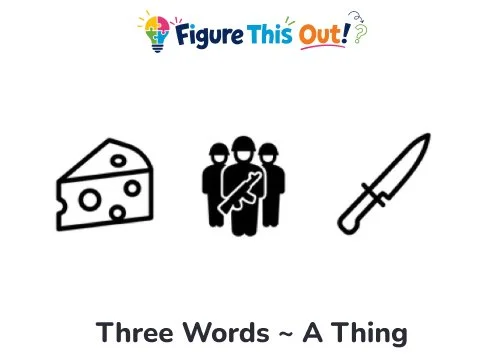
Swiss cheese plus tools and soldiers hint at a versatile pocket item.
-
Swiss Army Knife
The real test
The best compliment a party game can get isn't "that was clever." It's someone saying "one more" after they swore they were only watching. If a game can earn that without explaining how to play it, it belongs at the party.
Be first in line for our Kickstarter!
Kickstarter pricing: $25 early bird (first 25 backers) · $27 regular · shipping added at checkout.
A full deck of 110 large 5" × 3.5" puzzle cards.
